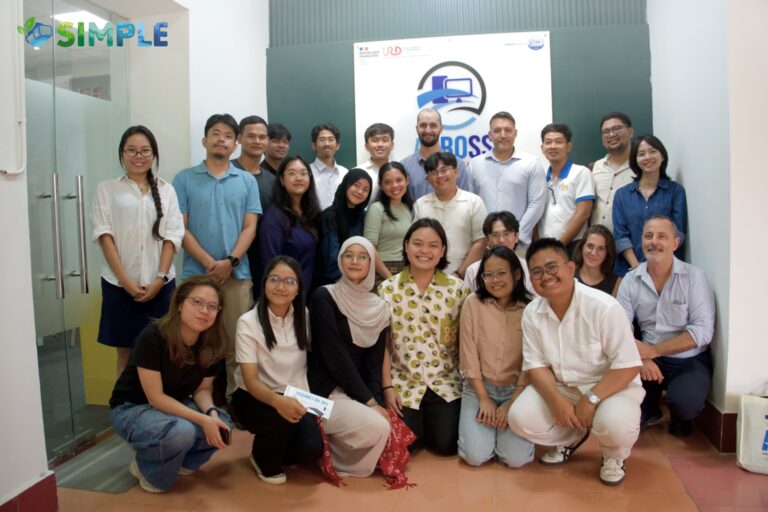
At IRD, the project involves members of the Mathematical and Computer Modelling of Complex Systems Research Unit (UMMISCO), the Advanced Computational Research On Sustainability Science (ACROSS) International Joint Laboratory and the IRD headquarters services on Capacity Building and Scientific Culture.
[Visit site]
At CTU, members of the College of Information and Communication Technology (CICT), the College of Environment and Natural Resources (CENRes) and the School of Education contribute to the project implementation, focusing on land subsidence and water salinity.
[Visit site]
At NSTDA, members of the National Center for Genetic Engineering and Biotechnology (BIOTEC) and Sirindorn Science Home contribute to the project implementation, focusing on forest biodiversity restoration.
[Visit site]
CADT leads the development of the Virtual Universe in Cambodia, focusing on the impacts of pesticides on insect biodiversity and sustainable agriculture in the Mekong region.
[Visit site]
BeDev Consulting, partnering with the National University of Laos (NUOL), leads the development of the Virtual Universe in Lao PDR, focusing on dengue fever awareness and prevention methods.
[Visit site]SIMPLE is a project co-funded by the European Union that aims to explore the value of virtual reality in raising young people’s awareness of the need to build sustainable solutions to environmental challenges.
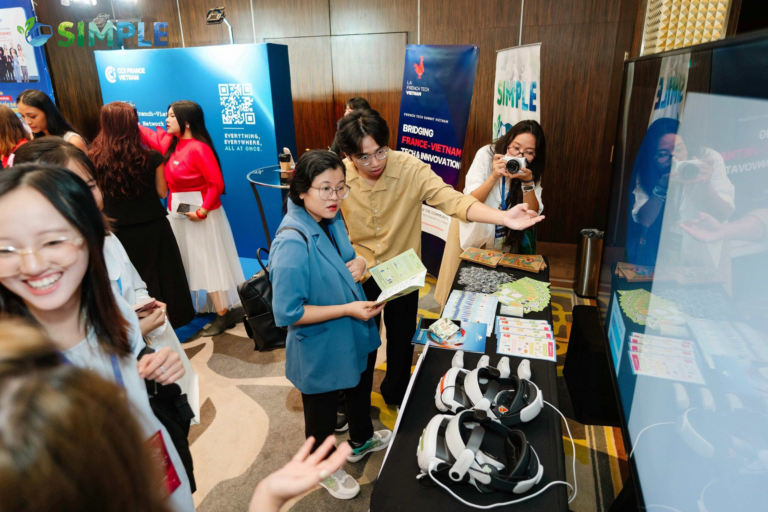
Within the project, SIMPLE has developed multiple 3D Virtual Universes (VUs), each accompanied by dedicated learning units, which are used to implement experiments based on virtual reality (VR) in schools.
To launch these experiments in classrooms, the project uses the M2L2 (Mobile Metaverse Learning Lab), its own dedicated device to easily deploy the necessary equipment to run VR game sessions smoothly.
A Virtual Universe (VU) is a 3D virtual world where students can explore and interact with scientific concepts. It uses Virtual Reality (VR) to create an immersive experience for students. The SIMPLE team has developed many VUs with different sustainability topics (salt intrusion, biodiversity, dengue fever and insect biodiversity) across four countries: Vietnam, Thailand, Lao PDR and Cambodia. You can explore the scientific message of our VUs here.
A learning unit is a structured plan or framework that describes how a learning experience will take place. It outlines what learners will do, what they will learn, and provides instructions to teachers on how to handle and adjust the activities and tools developed in SIMPLE (such as the VU). Within the SIMPLE project, a learning unit is designed along with the VUs to bring an immersive learning experience to the students.
A VR-based (Virtual Reality) experiment is an immersive learning experience where students explore a Virtual Universe (VU) using VR, guided by a dedicated learning unit. Through interactions, observations, and discussions, students gain a comprehensive understanding of sustainability issues and are encouraged to develop their own solutions.
The M2L2 which stands for Mobile Metaverse Learning Lab is a mobile device gathering all the necessary equipment to run virtual reality game sessions in educational environments. It has been elaborated so people with no technical background, particularly teachers, can drive the experiment.
Co-funded by the European Union. SIMPLE is led by IRD and implemented by its partners in the Lower Mekong region (CTU, NSTDA, CADT, BeDev) under the EU–ASEAN Green Partnership Programme.
This website was created and maintained with the financial support of the European Union. Its contents are the sole responsibility of SIMPLE and do not necessarily reflect the views of the European Union.


© Copyright SIMPLE. All right reserved. Powered by Letweb.